
Table of Contents
- Why Backup Generator Sizing Matters
- Understanding Generator Starting Watts vs Running Watts
- How to Use a Home Generator Sizing Calculator
- Identifying Essential Circuits for a Backup Generator
- Generator Sizing for Central Air Conditioning
- Calculating Your Total Backup Generator Needs
- Conclusion
- Frequently Asked Questions
Last Updated: October 17, 2026
Why Backup Generator Sizing Matters
Choosing the wrong generator size is one of the costliest mistakes homeowners make. Too small, and it won’t power your essential systems during an outage. Too large, and you’ve overspent on capacity you’ll never use while wasting fuel and space. The real problem isn’t finding a generator, it’s matching the right size to your home’s actual electrical demands.
At Strong Tower Solar Electrical Services & Generators LLC, we help homeowners avoid this trap by walking them through a systematic sizing process. Getting this right means the difference between a generator that protects your investment and one that leaves you scrambling when the power goes down.
A backup generator sizing guide helps you calculate exactly what you need based on your home’s electrical panel, your most critical circuits, and the appliances that matter most. This isn’t guesswork, it’s engineering. The process involves understanding two key measurements, identifying which circuits to prioritize, and accounting for the specific demands of high-load appliances like air conditioning units.
Most homeowners focus only on the largest appliance in their home, then size a generator around that single load. This creates a false sense of security. The real challenge is running multiple systems simultaneously, your HVAC, refrigerator, well pump, and lights all at once. That’s where most calculations fail.
Understanding Generator Starting Watts vs Running Watts
Every generator has two power ratings, and confusing them is the fastest way to buy the wrong size. Starting watts (also called inrush watts) is the surge of power needed when an appliance first turns on. Running watts (or rated watts) is the steady power an appliance needs once it’s operating.
The difference matters because large motors, compressors in air conditioners, well pumps, and refrigerators, demand a massive initial surge. A typical central air unit might need 3,500 starting watts but only 1,500 running watts once the compressor is spinning.
This is where many DIY sizing attempts break down. Online calculators that don’t account for starting watts will tell you a 5,000-watt generator is enough when you actually need 8,000 watts to handle the startup spike.
Strong Tower Solar Electrical Services & Generators LLC uses a dual-rating approach for sizing calculations. We identify your home’s largest motor loads, add their starting watts to your running load, then build in a safety margin. This ensures the generator can handle both the surge and the sustained draw without cutting out.
Always size your generator to the starting watts of your largest appliance, plus the running watts of everything else you want to run simultaneously. Ignoring starting watts is the single biggest reason generators fail to deliver power when homeowners expect them to.
How to Use a Home Generator Sizing Calculator
A home generator sizing calculator simplifies the process of identifying your total power needs. Rather than manually adding up every appliance, these tools let you select which circuits and devices you want to power, then automatically calculate the combined load.
The best calculators walk you through a step-by-step process: first, you identify your home’s main electrical panel amperage (usually 100, 150, or 200 amps). Next, you select which appliances and circuits matter most, your HVAC system, refrigerator, water heater, sump pump, lighting, and any other critical loads.
When using a generator sizing calculator, be honest about what you actually want to run. Don’t assume you’ll power everything in your home, that’s not realistic and leads to oversizing.
The calculator gives you a total running watts figure and a peak starting watts figure. Your generator’s rated capacity should exceed both numbers with a 10-15% safety buffer.
Many homeowners skip this step and rely on rough estimates. That’s where problems start. A generator sizing calculator removes the guesswork and gives you a defensible number to share with your installer.
Identifying Essential Circuits for a Backup Generator
Not every circuit in your home needs backup power. Identifying which ones do is the key to right-sizing your generator without overspending.
Start with the non-negotiables: your HVAC system (heating and cooling), refrigerator, water heater or well pump if you have one, and lighting in critical areas. If anyone in your household uses medical equipment, oxygen concentrators, CPAP machines, or powered mobility devices, those circuits take priority.
Everything else is secondary. Your electric dryer, electric range, pool pump, hot tub, and landscape lighting can wait. Prioritizing these non-essential circuits inflates your generator size and cost unnecessarily.
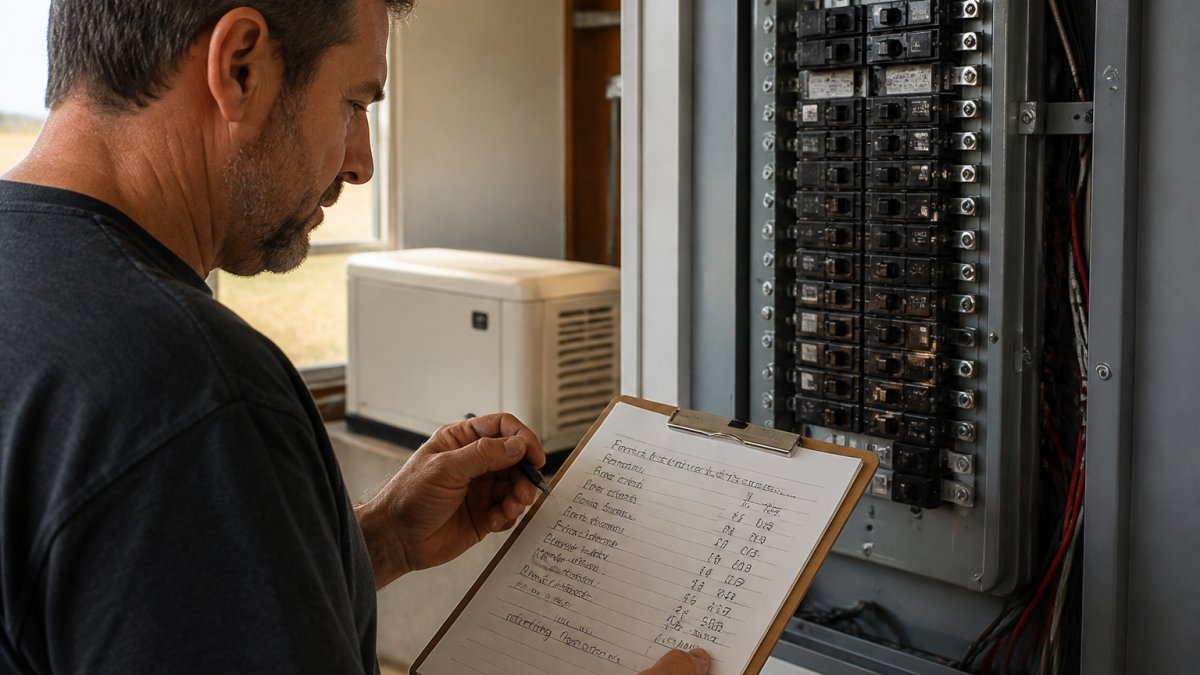
The way to identify essential circuits is to walk through your electrical panel with a flashsheet and note which breakers control which rooms and appliances. Your panel should have labels, if it doesn’t, that’s a safety issue worth addressing.
Strong Tower Solar Electrical Services & Generators LLC recommends a transfer switch installation that lets you manually select which circuits get backup power. This gives you flexibility: during a short outage, you might power just your refrigerator and lights.
Overloading a transfer switch is a common mistake. If you wire too many circuits to your backup power, you’ll trip the switch the moment the generator starts. This typically happens when homeowners assume they can run everything at once. The transfer switch has a maximum capacity, usually 30 or 50 amps depending on the model, and exceeding it defeats the purpose of having a generator.
Generator Sizing for Central Air Conditioning
Central air conditioning is the single largest power draw in most homes, and it’s also the most misunderstood when it comes to generator sizing. This deserves its own section because the numbers are counterintuitive.
A typical central air unit has a compressor (the motor that does the heavy lifting) and a blower fan. The compressor is what creates that massive starting surge.
The blower fan adds another 400 to 800 watts once the system is running.
Here’s where most sizing calculations fail: homeowners add the starting watts of the AC unit to the running watts of everything else they want to power simultaneously.
In Austin’s climate, air conditioning isn’t optional during an extended outage. If you size your generator too small to handle AC startup, you’re left with a generator that can’t do its primary job.
If your AC unit is older or oversized for your home, the starting watts can exceed 7,000.
Calculating Your Total Backup Generator Needs
Now that you understand starting watts, running watts, and which circuits matter, it’s time to calculate your actual backup generator sizing needs.
Start with a spreadsheet or worksheet. List every appliance and circuit you want to power. For each one, write down both the starting watts (if it has a motor) and the running watts. Here’s a realistic example for a mid-sized Austin home:
| Appliance/Circuit | Starting Watts | Running Watts |
|---|---|---|
| Central AC Unit | 5,000 | 2,500 |
| Water Heater | 0 | 4,500 |
| Refrigerator | 2,200 | 800 |
| Well Pump (if applicable) | 3,500 | 1,000 |
| Lighting & Outlets | 0 | 1,500 |
| Microwave | 0 | 1,000 |
| Total | 10,700 | 11,300 |
Your generator needs to handle the higher of these two numbers. In this case, the running watts total is higher, so you’d need a generator rated for at least 11,300 watts, but add 10-15% safety margin, bringing you to roughly 13,000 watts.
The reason this matters: if you buy a 10,000-watt generator, it will start up fine. But the moment multiple loads kick in simultaneously, you’ll exceed capacity and the generator will either shut down or the voltage will sag dangerously, potentially damaging sensitive electronics.
One critical detail many homeowners miss: if you have a large motor load like a well pump or compressor that starts frequently, you need to account for the fact that it might start while other appliances are already running.
Write down the nameplate data from your appliances themselves, not estimates. Open your electrical panel, look at the breaker sizes, and note them. Check the rating labels on your AC unit, water heater, and major appliances. This data is exact, guesses are not.
Conclusion
Right-sizing your backup generator starts with understanding the difference between starting and running watts, identifying which circuits truly need backup power, and calculating the combined demand of those circuits running simultaneously. Most homeowners either oversize their generator out of caution or undersize it by ignoring motor starting loads, both mistakes are expensive.
When power goes down in Austin, having a generator that’s actually sized for your home’s needs means the difference between a minor inconvenience and a serious problem. Strong Tower Solar Electrical Services & Generators LLC helps local homeowners install backup systems that truly work when they’re needed most. Our licensed team handles the full process, from calculating your exact backup generator sizing requirements to professional installation and ongoing maintenance. Get an estimate for a backup generator system tailored to your home’s specific electrical needs, and gain the peace of mind that comes with reliable backup power.
Frequently Asked Questions
What size backup generator do I need for my house?
The size depends on which appliances and systems you want to power. A whole-house generator typically ranges from 10 kW to 20 kW for most residential homes. If you’re powering only essential circuits (refrigerator, heating, lighting, water pump), you may need 5 kW to 10 kW. Start by adding the running watts of your must-have appliances, then add 25-30% for safety margin. A professional assessment from a licensed electrician ensures you get the right capacity for your specific needs.
How do starting watts differ from running watts?
Running watts (rated watts) represent the continuous power an appliance uses during normal operation. Starting watts (inrush watts) are the surge of power needed when an appliance first turns on, this can be 2-3 times higher than running watts. For example, an air conditioner might run at 3,500 watts but require 5,000+ starting watts when the compressor kicks in. When sizing a backup generator, you must account for starting watts of your largest motor-driven appliances to avoid overloading the system.
Can a generator run central air conditioning during a power outage?
Yes, but central air conditioning requires significant power. A typical central AC unit needs 3,500 to 5,000+ running watts and 5,000 to 15,000 starting watts depending on size and efficiency. If you want to run your central AC as a priority, your generator must be sized accordingly, usually 15 kW or larger. Many homeowners choose a mid-sized generator that powers essential circuits (heating, refrigerator, lighting, water) and skip the AC to manage costs. A licensed electrician can help you decide which approach fits your budget and comfort needs.
What appliances should I prioritize on my backup generator?
Essential circuits typically include your furnace or heating system, refrigerator, water heater (or water pump for wells), lighting, and medical equipment if applicable. During extended outages, these keep your home habitable and preserve food. Many homeowners also add their internet router, phone chargers, and garage door opener. Central air conditioning, hot tubs, and large water heaters consume significant power and are often deprioritized unless your generator is sized for whole-house coverage. Work with a professional to design circuits that match your priorities and budget.
How do I calculate generator size if I want to run multiple appliances at once?
Add the running watts of every appliance you want to operate simultaneously, then use the highest starting watts among those appliances. For example, if you run a refrigerator (600 running watts), furnace (1,000 running watts), and water heater (4,000 running watts) at the same time, your total is 5,600 running watts. If the water heater has 5,000 starting watts, your generator must handle at least 10,600 watts (5,600 running + 5,000 starting surge). A home generator sizing calculator or professional assessment helps ensure you don’t undersize.
Should I install a whole-house or portable backup generator?
Whole-house (standby) generators automatically detect power loss and switch on within seconds, powering pre-selected circuits or your entire home. They’re permanently installed, fuel themselves (natural gas or propane), and require regular maintenance. Portable generators are less expensive upfront but require manual setup, fuel storage, and extension cords, they’re better for temporary outages or RVs. For permanent home protection, especially if you have an all-electric home or rely on well pumps, a standby generator is more reliable. A licensed electrician can assess your property and recommend the best option.
What maintenance does a backup generator need?
Standby generators require monthly exercise runs (5-10 minutes under load) to keep the engine ready and fuel system clean. Annually, a professional should inspect the battery, fuel lines, oil level, and transfer switch to ensure everything functions properly. Natural gas and propane generators need less fuel maintenance than diesel models. Portable generators require oil changes, spark plug checks, and fuel stabilizer if stored long-term. Regular maintenance prevents failure during emergencies. Many homeowners schedule service each spring before storm season to ensure their generator is ready.