
Table of Contents
- Why Annual Maintenance Is Essential for Standby Generators
- Recommended Maintenance Schedule: Time vs. Operating Hours
- Monthly Maintenance Checklist for Backup Generator Performance
- How Often to Change Generator Oil and Other Fluid Levels
- Quarterly and Annual Professional Tune-Up Requirements
- DIY Generator Maintenance Checklist and When to Call a Technician
- Home Standby Generator Maintenance Cost and Warranty Compliance
- Post-Storm Maintenance and Seasonal Preparation
- Frequently Asked Questions
Last Updated: September 20, 2026
Why Annual Maintenance Is Essential for Standby Generators
Your standby generator is only as reliable as the care you invest in it. Annual maintenance isn’t optional, it’s the difference between a system that starts immediately and one that fails when you need it most.
A properly maintained standby generator can run for 20+ years; neglected units fail within 5-10 years.
Schedule your annual professional service before storm season arrives. Most technicians get booked in late spring and early summer. Waiting until September means longer wait times and higher urgency fees.
Recommended Maintenance Schedule: Time vs. Operating Hours
Most manufacturers recommend servicing based on whichever comes first: annual service or every 200-400 operating hours.
For most residential standby generators, this translates to:
- Monthly visual inspections (15 minutes)
- Quarterly fluid level checks (20 minutes)
- Semi-annual load testing (30-45 minutes)
- Annual professional tune-up (2-3 hours)
Monthly Maintenance Checklist for Backup Generator Performance
Monthly checks take 15 minutes and catch problems before they become expensive.
Monthly inspection steps:
- Check fuel level in the tank
- Inspect the enclosure for debris, standing water, or pest damage
- Look for visible oil leaks around the engine and generator head
- Verify the battery voltage (should read 12-13.5 volts on the display or with a multimeter)
- Ensure the automatic transfer switch indicator shows “Ready” status
- Check that cooling vents are clear and unobstructed
- Listen during the weekly self-test cycle for unusual noises or vibrations
If the battery voltage drops below 11 volts, the generator may not start during an actual power outage. Weak batteries fail silently, the unit appears ready until you actually need it. Replace the battery immediately or schedule a service call.
How Often to Change Generator Oil and Other Fluid Levels
Oil change intervals and fluid maintenance vary significantly by fuel type. Understanding these differences prevents over-servicing and under-servicing.
Natural Gas Generators: Longest Service Intervals
Propane Generators: Moderate Service Intervals
Diesel Generators: Shortest Service Intervals and Most Complex Maintenance
Fuel Degradation: The Hidden Killer
Fluid Maintenance by Fuel Type: Quick Reference
| Maintenance Task | Natural Gas | Propane | Diesel |
|---|---|---|---|
| Oil change interval | 500-1,000 hrs or 1 yr | 300-500 hrs or 1 yr | 200-400 hrs or 1 yr |
| Fuel stabilizer needed | No | No | Yes (every 6 mo if idle) |
| Fuel filter changes | N/A | N/A | Every 200-400 hrs |
| Tank inspection | N/A | Every 12 months | Every 6 months |
| Water separator drain | N/A | If present, monthly | Monthly if used frequently |
| Coolant flush interval | Every 3-5 years | Every 3-5 years | Every 2-3 years |
| Spark/glow plug interval | Every 500 hrs | Every 300 hrs | Every 1,000-2,000 hrs |
Checking Fluid Levels: The Monthly Ritual
Perform these checks monthly:
- Engine oil: Should be between MIN and MAX marks on the dipstick. Top up with the manufacturer-recommended grade if low. Never overfill.
- Coolant: Check the coolant reservoir. Low coolant indicates a potential leak needing professional attention. Never open the radiator cap when hot.
- Battery electrolyte: Modern sealed batteries don’t require this. Older flooded-cell batteries may need distilled water top-ups.
- Fuel level: For propane and diesel, verify the tank has adequate fuel.
Keep a simple log of fluid levels checked each month. Note the date, oil level, coolant level (if applicable), and any issues observed. This log becomes valuable documentation if a warranty claim is ever needed, and it helps you spot trends (e.g., oil level dropping faster than normal, which indicates a leak).
Never mix fuel types or use the wrong oil grade to save money. A $50 mistake on oil selection can cause $5,000 in engine damage. Always consult your owner’s manual for exact specifications.
Quarterly and Annual Professional Tune-Up Requirements
Quarterly checks go deeper than monthly inspections. A qualified technician will perform load bank testing, inspect electrical connections, and verify system diagnostics.
The single most important service visit is the first one after installation. It establishes a baseline for your specific unit and catches any installation issues before they become problems.
DIY Generator Maintenance Checklist and When to Call a Technician
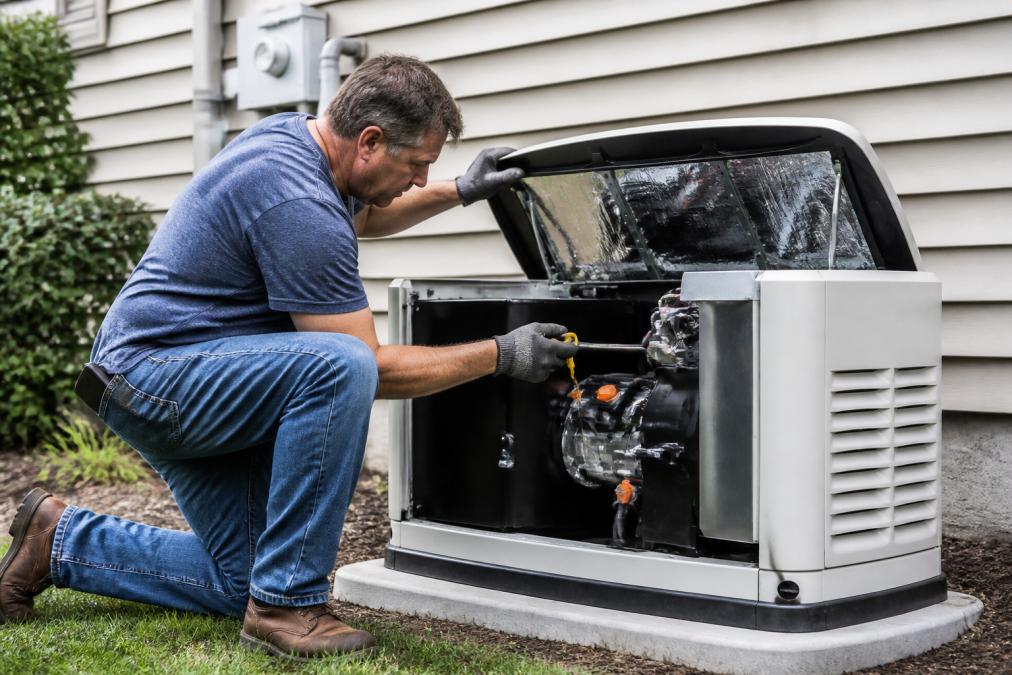
You can handle monthly and basic quarterly checks yourself. Know your limits, some tasks require licensed electricians and specialized equipment.
DIY tasks (safe for homeowners):
- Monthly visual inspections
- Checking fuel and fluid levels
- Cleaning debris from vents and enclosure
- Verifying battery voltage with a multimeter
- Running the weekly self-test cycle
- Topping up oil or coolant (if manufacturer-approved)
- Documenting maintenance in a log
Professional-only tasks:
- Load bank testing (requires specialized equipment)
- Oil and filter changes (if you’re uncomfortable with this)
- Spark plug replacement or inspection
- Valve clearance adjustment
- Coolant flush procedures
- Electrical connection cleaning and tightening
- Automatic transfer switch diagnostics
- Error code troubleshooting
- Fuel system inspection or cleaning
Home Standby Generator Maintenance Cost and Warranty Compliance
The annual investment in preventative maintenance is far less than emergency repair calls or equipment replacement. However, warranty compliance is where most homeowners make costly mistakes.
Why Documentation Matters
Building Your Warranty File
- Original warranty document, Keep the full warranty terms, not just the summary
- Installation certificate, Proof the unit was installed by an authorized technician
- Every service invoice, Even routine monthly checks, if documented by a professional
- Load test reports, Critical for proving the unit was tested under load
- Battery replacement receipts, With date and part number
- Fuel stabilizer purchases, If you add stabilizer, keep receipts to show fuel maintenance
- Photographs of the installation, Date-stamped photos showing the unit’s condition and location
- Email confirmations, Any correspondence with the manufacturer or service provider about issues
What to Ask Your Service Provider
When scheduling professional maintenance, explicitly ask:
- “Will you provide detailed documentation that meets [manufacturer name] warranty requirements?”
- “Can you send service records directly to the manufacturer’s system?” (Some authorized dealers can file records electronically)
- “What is your technician’s license number and certification?” (Warranty often requires licensed electricians)
- “Will you perform load bank testing and provide the results in writing?”
- “Can I get a copy of the service report immediately, not mailed later?”
If your generator fails and you attempt to file a warranty claim without complete service documentation, expect the claim to be denied or delayed by 4-8 weeks while the manufacturer investigates. Documented maintenance prevents this entirely.
Post-Storm Maintenance and Seasonal Preparation
After any storm where your generator ran, schedule a professional inspection within 48 hours.
Homeowners in areas with seasonal power outages (hurricanes, ice storms, wildfires) should complete seasonal preparation at least 30 days before the typical storm season. This leaves time for repairs if issues are discovered.
Frequently Asked Questions
How often should a residential backup generator be serviced?
A standby generator should be serviced annually by a qualified technician, with regular fluid checks. If your unit operates frequently, consider increasing professional service visits. Operating hours matter more than calendar time, check your generator’s meter regularly. Most manufacturers require annual service to maintain warranty validation and ensure the automatic transfer switch and electrical connections function properly during an actual outage.
How often to change generator oil and maintain fluid levels?
Change generator oil annually or as recommended by the manufacturer. Check oil levels monthly before each test run. Coolant flush is typically needed per manufacturer specifications. Battery voltage should be checked monthly and the battery charger tested regularly. Fuel stabilization is critical if your generator sits unused, add stabilizer to the tank during idle periods to prevent sediment trap buildup and fuel degradation.
What is included in a standard home generator maintenance checklist?
A complete monthly checklist includes visual inspection of the enclosure, checking fluid levels (oil, coolant, fuel), testing the automatic transfer switch, verifying battery voltage, and running the generator. Quarterly tasks add filter element inspection and electrical connections review. Annual professional service covers spark plug inspection, valve clearance adjustment, load testing, system diagnostics, and exhaust system inspection. Document all maintenance in writing to maintain warranty compliance.
Can I perform my own generator maintenance or do I need a professional?
You can handle monthly checks like fluid level inspections and visual enclosure inspection yourself. However, annual tune-ups, load bank testing, valve clearance adjustment, and component wear assessment require a qualified technician with proper diagnostic equipment. DIY maintenance helps catch problems early, but manufacturer warranty often requires professional service intervals to remain valid. Post-storm maintenance and troubleshooting error codes should always be performed by a licensed professional to ensure safety and proper system diagnostics.
What are the signs that my backup generator needs immediate service?
Seek immediate professional help if your generator fails to start, produces unusual noises or vibrations, shows low battery voltage (below 12 volts), displays error codes on the control panel, has visible fuel leaks, or runs at abnormal RPM. Black or white exhaust smoke, difficulty with the automatic transfer switch activation, or overheating are also red flags. Post-storm, inspect for physical damage to the enclosure and electrical connections. Never ignore warning signs, immediate service prevents costly failures when you need emergency power most.
How does preventative maintenance extend the lifespan of a standby generator?
Regular maintenance prevents component wear, keeps fuel quality stable, maintains proper fluid levels, and ensures electrical connections remain secure. Load bank testing under actual operating conditions identifies issues before they cause failure. Seasonal prep and fuel stabilization prevent corrosion and sediment buildup. Regular maintenance helps a generator operate reliably for an extended period, while neglected units may fail prematurely. Warranty validation also requires documented preventative maintenance, protecting your investment long-term.
What fuel type-specific maintenance do I need to know about?
Natural gas generators require less frequent fuel maintenance but need annual pressure line inspections. Diesel units demand regular fuel stabilization and sediment trap cleaning to prevent injector fouling. Propane systems need annual regulator inspection and leak testing. All fuel types benefit from seasonal prep, add stabilizer before winter storage and inspect fuel delivery systems before hurricane season. Check your generator’s manual for fuel-specific service intervals.