
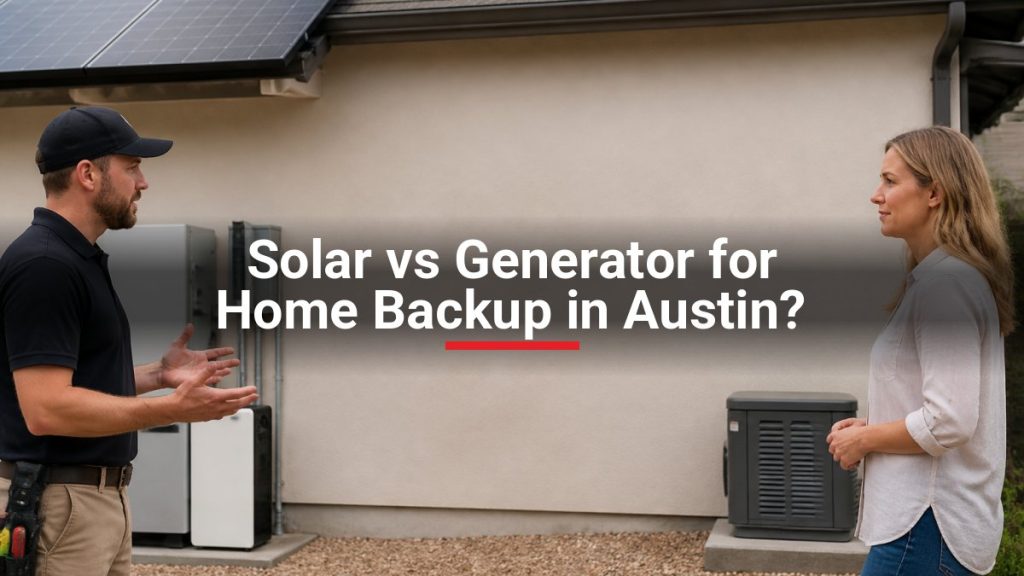
Last Updated: October 25, 2026
Quick Summary
Solar vs generator for home backup in Austin depends on your priorities: solar battery backup offers quiet, fuel-free operation with higher upfront costs, while standby generators provide reliable whole-house power on demand with lower initial investment but require ongoing fuel and maintenance. Many Austin homeowners choose both systems combined for complete backup coverage.
- Solar batteries power essential loads for 8-12 hours or whole homes for 4-6 hours depending on capacity
- Standby generators produce 70-90 decibels and require monthly tests and seasonal maintenance
- Generators run indefinitely with fuel supply while batteries deplete after stored energy is consumed
- Solar battery systems have higher upfront costs but zero fuel expenses over time
- Austin’s summer outages often occur during peak solar production, extending battery runtime
Table of Contents
- Solar vs Generator: Quick Comparison for Austin Homes
- How Solar Battery Backup vs Generator Performance Differs
- Understanding Home Battery Backup vs Whole House Generator Capabilities
- Solar Battery Runtime During Power Outage: What to Expect
- Cost and Maintenance: Which Option Fits Your Budget
- Standby Generator Installation in Austin: What You Need to Know
- Getting Your Backup Power System Installed
- Frequently Asked Questions
Solar vs Generator: Quick Comparison for Austin Homes
When Austin homeowners face the choice between solar battery backup and a standby generator, the decision hinges on three core factors: runtime during outages, upfront costs, and ongoing maintenance. At Strong Tower Solar Electrical Services & Generators LLC, we help homeowners evaluate both options based on their actual power needs and budget constraints.
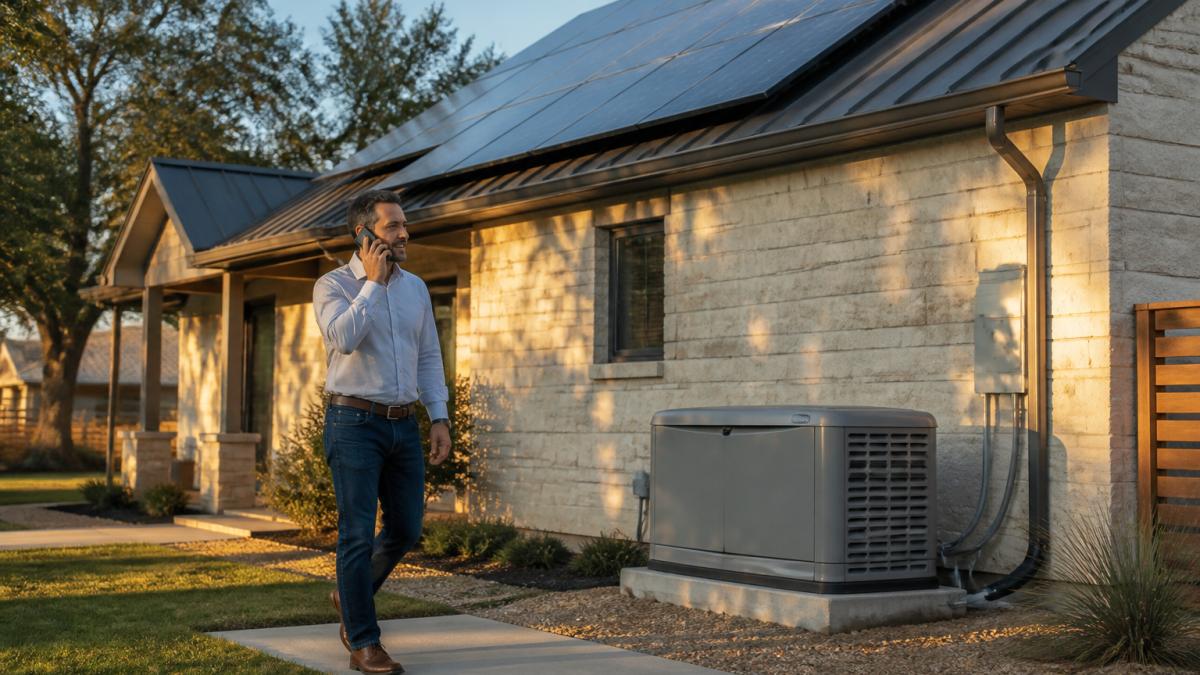
The choice between solar vs generator for home backup in Austin isn’t about which is universally better, it’s about which fits your situation. Solar battery systems provide quiet, fuel-free backup power that generates electricity during the day. Generators deliver reliable whole-house power on demand but require fuel, regular maintenance, and produce noise and emissions. Understanding the performance differences helps clarify which solution makes sense for your home.
| Feature | Solar Battery Backup | Standby Generator |
|---|---|---|
| Power source | Stored solar energy | Fuel (natural gas or propane) |
| Runtime | Limited by battery capacity | Unlimited with fuel supply |
| Noise level | Silent operation | 70-90 decibels |
| Maintenance | Annual inspections | Monthly tests, seasonal service |
| Upfront cost | Higher initial investment | Lower unit cost |
| Fuel costs | None after installation | Ongoing fuel expenses |
| Installation | Rooftop panels + battery | Ground-mounted unit |
How Solar Battery Backup vs Generator Performance Differs
Solar battery backup and standby generators operate on fundamentally different principles. A solar battery system stores energy generated by your rooftop panels during daylight hours. When the grid fails, that stored energy powers your home until the battery depletes or daylight returns. A standby generator, by contrast, detects a power outage and automatically starts a fuel-powered engine that supplies electricity to your entire home.
The practical difference shows up immediately during an outage. A generator begins supplying power within seconds of detecting the outage, no waiting, no limits. Solar battery backup depends on how much energy you’ve stored and how much power you’re using. A fully charged battery might sustain essential circuits for several hours or your whole house for a few hours, depending on system size and load.
Generator performance remains consistent regardless of weather or season. Solar battery performance declines on cloudy days and during winter months when sunlight is limited, which is why understanding solar energy system maintenance helps maximize reliability. Solar battery performance declines on cloudy days and during winter months when sunlight is limited. This matters in Austin, where summer heat can strain the grid during peak demand, but winter storms occasionally knock out power when solar production is lower.
One critical difference: generators require fuel to operate. During extended outages, fuel availability becomes a constraint. Solar batteries don’t deplete from sitting idle, they’re ready whenever you need them, year after year.
Understanding Home Battery Backup vs Whole House Generator Capabilities
A home battery backup system powers specific circuits or your entire home depending on capacity. Most residential battery systems range from 10 to 15 kilowatt-hours of storage. That’s enough to run essential loads (refrigerator, lights, internet, medical equipment) for 8-12 hours, or your whole house at moderate usage for 4-6 hours. Adding more batteries increases storage and extends runtime.
A whole house generator typically ranges from 7 to 20 kilowatts of power output. That capacity determines how many appliances can run simultaneously. A 10-kilowatt generator can power your HVAC system, electric water heater, and kitchen appliances all at once. A 20-kilowatt unit handles larger homes with higher simultaneous demand. Unlike batteries, generator capacity doesn’t deplete, it’s available as long as fuel lasts.
The capability difference becomes clear during extended outages. A battery system that powered your home for six hours is empty after six hours unless it’s recharging from solar panels or the grid. A generator can run indefinitely if you have fuel. For multi-day outages, a generator is more practical unless you combine solar battery backup with a generator as a hybrid system.
Home battery backup excels at handling brief outages (hours to a day). Whole house generators excel at handling extended outages (days or weeks) when fuel supply remains available.
Solar Battery Runtime During Power Outage: What to Expect
Solar battery runtime during an outage depends on three variables: battery capacity, your home’s power consumption, and whether the sun is shining. A 10-kilowatt-hour battery powering essential loads (refrigerator, lights, internet, one air conditioning zone) might last 12-16 hours. The same battery powering your entire home at normal usage might last 4-6 hours.
Daylight hours matter significantly. If your outage occurs during the day and weather permits, your solar panels continue generating electricity, extending your runtime indefinitely. If the outage happens at night or during cloudy weather, you’re drawing down your stored battery with no recharge happening.
Austin’s climate offers an advantage here. Summer outages often occur during peak afternoon heat, when solar panels generate maximum power. Winter outages are less common but occur when solar production is lower. Planning your battery capacity around your region’s typical outage patterns makes sense.
Most Austin homeowners size their battery systems to cover essential loads for 8-12 hours. That bridges a typical overnight outage or allows time for solar panels to recharge during the next day. Larger batteries cost more but provide longer runtime and more flexibility during extended outages.
Cost and Maintenance: Which Option Fits Your Budget
Upfront costs differ significantly. For homeowners considering only the battery component without new solar panels, costs vary based on existing system size and battery capacity.
These numbers tell only part of the story. Generators require ongoing fuel costs and regular maintenance to stay reliable. Monthly load tests, seasonal service, and fuel stabilization add up over time. Solar battery systems require annual inspections and occasional software updates but no fuel costs.
Installation costs matter too. Learn the cost of residential solar panel installation to compare with generator expenses. Standby generators require electrical permits, fuel line installation, and automatic transfer switches. Solar battery systems require rooftop work, electrical integration, and battery enclosure setup. Both demand licensed electricians for code-compliant installation.
For long-term cost comparison, consider your expected ownership period. A generator’s operating costs accumulate over years. A battery system’s costs are front-loaded but decline over time as fuel expenses never materialize.
Standby Generator Installation in Austin: What You Need to Know
Standby generator installation in Austin requires permits, proper placement, and professional electrical integration. Your generator needs a concrete pad, fuel line connections (natural gas or propane), and an automatic transfer switch that detects outages and routes power from the generator to your home’s electrical panel.
Installation location matters. The unit should sit on level ground, away from windows and doors, with adequate ventilation. Noise considerations are real, generators produce 70-90 decibels of sound, similar to a lawnmower. Placing it on the far side of your property reduces noise impact on neighbors.
Natural gas generators offer convenience because fuel delivery is automatic through your existing gas line. Propane generators provide flexibility for properties without natural gas service. Both require professional installation to meet electrical codes and ensure safety.
Austin’s electrical codes require licensed electricians for all generator work. Improper installation can damage your home’s electrical system or create safety hazards. Strong Tower Solar Electrical Services & Generators LLC provides professional standby generator installation throughout the Austin area, ensuring code compliance and reliable operation.
Getting Your Backup Power System Installed
Installation timing matters. Spring and early fall are ideal seasons for both solar and generator work, before summer heat or winter weather complicates the process. Emergency installations are possible but cost more and face longer wait times if outages are widespread.
The installation process differs between solar and generator systems. Solar installation requires rooftop assessment, structural evaluation, electrical integration, and interconnection with the grid. Generator installation focuses on fuel supply, electrical connections, and transfer switch setup. Both require inspections before the system becomes operational.
Choosing a licensed, insured contractor protects you legally and ensures quality workmanship. Strong Tower Solar Electrical Services & Generators LLC’s team includes master electricians and solar professionals who deliver code-compliant installations. Get started with a free estimate to understand your installation requirements and timeline.
The choice between solar vs generator for home backup in Austin comes down to your priorities. If you value quiet, fuel-free operation and have the upfront budget, solar battery backup delivers long-term value. If you need reliable whole-house power for extended outages and prefer lower initial costs, a standby generator is practical. Many Austin homeowners choose both, combining solar battery backup with a generator creates redundancy that handles any outage scenario. Strong Tower Solar Electrical Services & Generators LLC can assess your home’s power needs, evaluate both options, and install a system tailored to your situation. Contact us for a free consultation and discover which backup power solution fits your home best.
Frequently Asked Questions
Is solar battery backup better than a generator for an Austin home?
Neither is universally better, it depends on your priorities. Solar battery backup works well if you want long-term energy savings and quiet operation, but requires sufficient roof space and sunny conditions. Generators provide immediate, fuel-based power and work regardless of weather or time of day, but require ongoing fuel and maintenance. Many Austin homeowners use both together for maximum reliability. Your choice depends on budget, available space, and how long you need backup power during outages.
How long can a home battery power a house during an outage?
A home battery system typically provides backup power for an average household, depending on battery capacity and your home’s energy consumption. For extended outages lasting days, you’ll need either multiple batteries or a generator to recharge the system. Strong Tower Solar can help size a system for your specific usage patterns.
Can solar panels charge a home battery during a Texas power outage?
Yes, solar panels can charge a home battery during a power outage, but only during daylight hours and only if your system is properly configured with an inverter and charge controller. If an outage occurs at night, your battery relies on stored energy until sunrise. Texas weather, including cloudy days and storms, reduces charging speed. A hybrid system combining solar, battery, and a standby generator ensures you have power around the clock regardless of weather or time of day.
Which backup power option requires less maintenance?
Solar battery systems require minimal maintenance: occasional panel cleaning and battery monitoring. Standby generators require regular maintenance, including oil changes, fuel stabilization, load testing, and annual servicing to ensure they start reliably during an outage. Neglected generators often fail when needed most. If low maintenance is important to you, solar battery backup is the easier choice. However, generators are more reliable during extended outages when battery capacity runs out. Strong Tower Solar’s licensed technicians can handle maintenance for either system.
