
Table of Contents
- Level 1 vs Level 2: Choosing the Right Charger
- Is Your Electrical Panel Ready for an EV Charger?
- Hiring a Licensed Electrician for EV Installation
- Permits, Inspections, and Electrical Code Requirements
- Step-by-Step: How to Install an EV Charger at Home
- EV Charger Installation Cost: What to Expect
- Tax Credits and Utility Rebates for EV Charger Installation
- Wi-Fi Setup and Troubleshooting After Installation
- Frequently Asked Questions
Last Updated: September 18, 2026
Level 1 vs Level 2: Choosing the Right Charger
Most homeowners who want to install EV charger equipment ask which charger they need. The answer comes down to speed, wiring, and how you’ll use the car.
A Level 1 charger plugs into a standard 120-volt wall outlet and adds roughly 3-5 miles of range per hour, often enough overnight for a plug-in hybrid or low-mileage commuter.
A Level 2 charger runs on a 240-volt circuit. It adds 20-30 miles of range per hour, filling most EVs in a few hours. This is the setup most drivers want.
Level 2 units come in two flavors, and the choice matters for your install:
| Feature | Plug-In EVSE | Hardwired EVSE |
|---|---|---|
| Power source | NEMA 14-50 or 6-50 outlet | Direct wiring to circuit |
| Amperage | Usually capped at 40A | Up to 48A or higher |
| Portability | Can unplug and move | Fixed in place |
| Extra outlet cost | Yes, plus GFCI breaker | None |
| Best for | Renters, frequent movers | Permanent home setups |
Plug-In vs Hardwired EVSE
Plug-in units are flexible, you can take the charging cable with you if you move, but they have a lower amperage ceiling and require a 240-volt outlet.
Hardwired units deliver more power and skip the outlet entirely. The U.S. Department of Energy guidance on home charging notes that hardwired connections often qualify for higher current and fewer points of failure. For a dedicated home charger, hardwired is usually the better call.
Is Your Electrical Panel Ready for an EV Charger?
Not always. Many homes built before the 1990s have a 100-amp panel already near its limit. A 48-amp Level 2 charger draws 48 amps continuously, and the National Electrical Code treats EV charging as a continuous load, so the circuit must be sized at 125% of the charger’s rating, a 60A dedicated breaker for a 48A charger. That’s a lot of headroom to find in a 100A panel already feeding a range, dryer, water heater, and central air.
An electrician runs a load calculation, adding up existing appliance, lighting, and HVAC demand using square footage and nameplate ratings, then comparing the total to your service capacity. If the numbers don’t work, your options depend on your specific panel, not a generic rule of thumb.
Never assume a spare breaker slot means you have capacity. A panel can have open slots and still be overloaded. Only a load calculation tells you the truth, and skipping it can trip your main breaker or overheat wiring.
Do You Need an Electrical Panel Upgrade for an EV Charger?
Sometimes. If your load calculation comes up short, a 200-amp panel upgrade may be the cleanest fix, replacing the panel, main breaker, and often the service entrance wiring and meter socket. It’s a bigger job, but it future-proofs your home for upgrades like a heat pump, induction range, or a second EV.
A panel upgrade is also the most expensive path. Before committing, ask your electrician whether a load management device could reach the same charger amperage without touching the service.
Load Management Systems: An Alternative to Upgrading
You don’t always need a full panel upgrade.
An Electric Vehicle Energy Management System (EVEMS), also called a load management device, monitors your home’s total electrical draw in real time and reduces or pauses charger output when other appliances spike, letting a large charger share capacity with your existing service.
Mechanically, a current transformer (CT) clamps around your service conductors or main feeder and reports live amperage to a controller. When total draw nears a set threshold, the controller signals the EVSE to throttle down or stop; when the dryer or oven cycles off, the charger ramps back up. The car still charges, just not always at full speed.
For older homes with 100A service, this can save thousands versus a panel replacement. The trade-off: charging may be slower during peak household demand, and jurisdictions treat EVEMS differently, some require a specific listing or permit amendment, others accept it as standard load management under the NEC. Ask your electrician whether your setup and local authority qualify before buying hardware.
If your electrician only offers a panel upgrade and never mentions load management, get a second opinion. EVEMS is a legitimate alternative for many homes, and the cost difference is often significant.
Quick Reference: Panel Capacity Scenarios
| Situation | Likely Path |
|---|---|
| 200A panel, open breaker space, short wire run | Standard 40-48A circuit, no upgrade |
| 200A panel, limited space, long run | Possible subpanel or load management |
| 100A panel, light household load | Load management device likely viable |
| 100A panel, heavy electric load (range, dryer, heat) | Panel upgrade or EVEMS with strict limits |
| 60A or fuse box service | Service upgrade almost always required |
These are patterns, not rules. Only an on-site load calculation and a conversation with your local inspector settle the question.
Hiring a Licensed Electrician for EV Installation
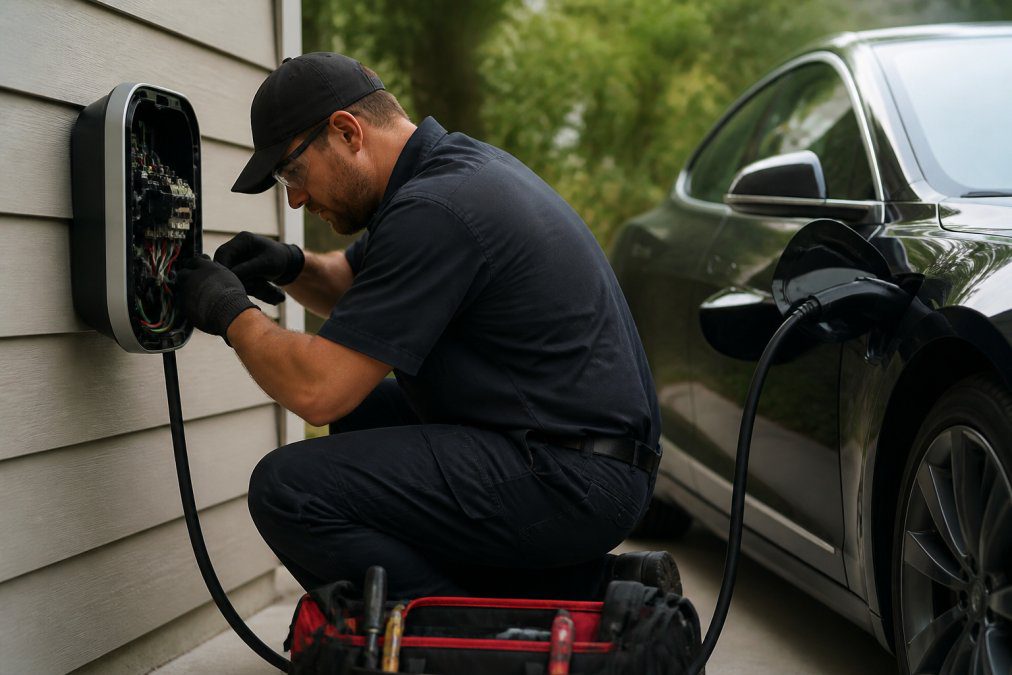
This is not a DIY job for most people. To install EV charger equipment safely means dealing with high-voltage wiring, dedicated circuits, and code compliance. Mistakes can cause fires.
What should you look for?
- Active state license and proof of insurance
- Experience with EVSE, not just general wiring
- Willingness to pull a permit (a red flag if they won’t)
- Clear written estimate before work starts
Ask for the electrician’s license number and verify it with your state licensing board before work begins. A quick check takes two minutes and protects you from unlicensed work.
Permits, Inspections, and Electrical Code Requirements
A permit is almost always required for a new 240-volt circuit. It triggers an inspection, and the inspector confirms the work meets the National Electrical Code and local amendments.
The inspection typically covers:
- Circuit breaker sizing and type
- Wire gauge and grounding
- GFCI protection where required
- Mounting height and clearances
Step-by-Step: How to Install an EV Charger at Home
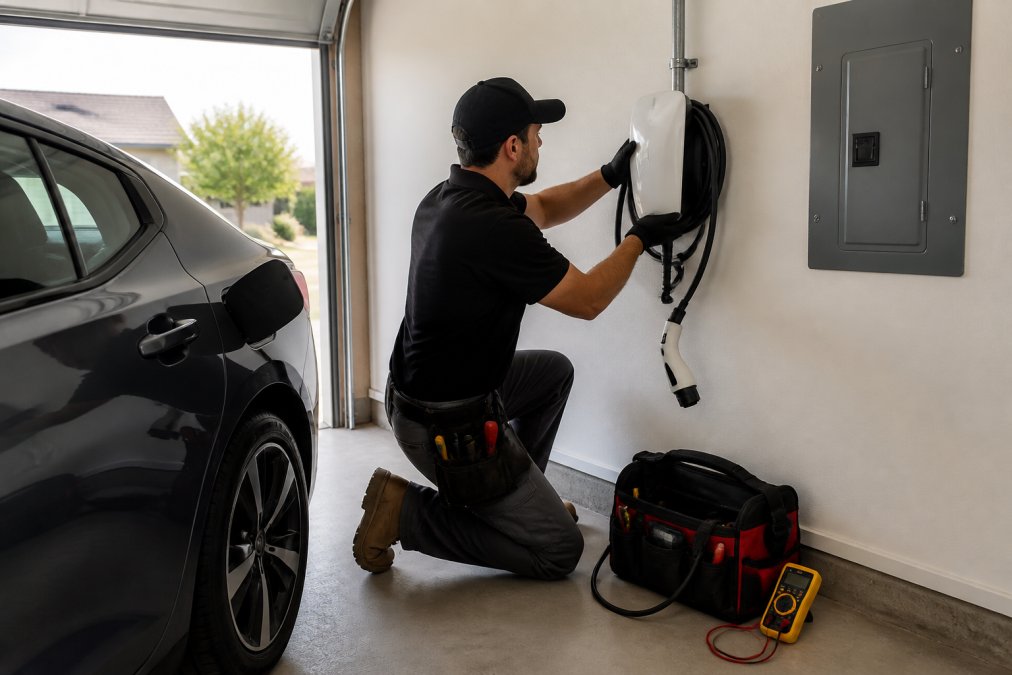
Here’s the real process, from first call to first charge.
What You’ll Need Before You Start
- A clear parking spot within cable reach of the charger
- Access to your electrical panel for the electrician
- Your EV’s connector type confirmed (J1772 or NACS)
- The permit pulled and approved
EV Charger Installation Cost: What to Expect
Pricing varies by home, but here’s a realistic range and what drives the cost.
Here’s what drives the spread:
- Distance from panel to charger. Longer runs mean more copper and more labor hours.
- Panel capacity. A panel upgrade adds significant cost.
- Plug-in vs hardwired. Hardwired units often cost less to install because there’s no outlet or GFCI breaker.
- Wall type and access. Finished drywall, brick, or a detached structure all add labor.
- Permit and inspection fees. These vary by jurisdiction.
Federal Tax Credit for EV Charger Installation
The Alternative Fuel Vehicle Refueling Property Credit has historically covered a percentage of qualified home EV charging equipment and installation costs, subject to a cap, for taxpayers in qualifying areas. Rules, caps, and geographic requirements have changed, so verify current terms on the IRS website before you buy.
Utility Rebates and Off-Peak Programs
Your utility rebate is the other lever, and it’s often overlooked. Many power companies offer:
- A flat rebate for installing a qualified smart charger
- A discounted or separate meter for EV charging
- Time-of-use (TOU) rate plans that make overnight charging significantly cheaper than peak-hour charging
- Bill credits for enrolling the charger in a managed charging program
Stack the incentives: federal credit + utility rebate + off-peak rate. Each one alone is modest; together they can meaningfully change the payback on your install.
Tax Credits and Utility Rebates for EV Charger Installation
IRS guidance on the alternative fuel vehicle refueling property credit
Wi-Fi Setup and Troubleshooting After Installation
A smart charger connects to Wi-Fi for scheduling, energy tracking, and remote control. Setup is usually simple.
- Download the charger’s app.
- Connect the charger to your 2.4 GHz Wi-Fi network.
- Create a charging schedule to charge off-peak.
- Set current limits if your panel needs it.
If the charger won’t connect, common fixes include:
- Confirm you’re on 2.4 GHz, not 5 GHz
- Move your router closer or add a mesh node
- Restart the charger at the breaker
- Update the charger’s firmware
Frequently Asked Questions
Can I install a home EV charger myself?
Most homeowners can handle the physical mounting, but the electrical work is where it gets risky. A Level 2 charger needs a dedicated 240V circuit, correct amperage, and a breaker sized to match, all of which must meet the National Electrical Code. Mistakes can cause overheating, tripped breakers, or worse. Hiring a licensed electrician keeps the job code-compliant and protects your insurance coverage if something goes wrong later.
How much does it cost to install an EV charger in a home?
EV charger installation cost depends on several factors: the distance from your electrical panel to the charger location, whether you need a panel upgrade, permit fees, and whether the unit is hardwired or plug-in. A simple install close to the panel costs far less than one requiring a long conduit run or a service upgrade. Get a free estimate from a licensed electrician so you know the real number for your home before committing.
Do I need a permit to install an EV charger at home?
In most jurisdictions, yes. A permit ensures the work meets local electrical code and triggers an inspection after installation. Skipping the permit can void your homeowner’s insurance and create problems when you sell the house. Your electrician typically pulls the permit on your behalf, handles the inspection scheduling, and provides documentation showing the work was done to code.
How do I know if my electrical panel can support an EV charger?
A licensed electrician performs a load calculation to determine whether your panel has enough spare capacity. A typical Level 2 charger draws 32 to 48 amps, which is a significant load. If your panel is already near capacity, you may need an electrical panel upgrade for an EV charger or a load management system that pauses charging when other high-draw appliances run. An on-site assessment gives you a definitive answer.