
Table of Contents
- Why Older Electrical Panels Struggle With EV Chargers
- How to Assess Your Panel’s Capacity for EV Charging
- Understanding Load Calculation for EV Chargers
- Smart EV Charger Load Management Solutions
- Electrical Panel Upgrade Cost in Austin and Upgrade Options
- Safety and Code Compliance Considerations
- Next Steps: Getting Your Panel Evaluated
- Frequently Asked Questions
Last Updated: October 7, 2026
Why Older Electrical Panels Struggle With EV Chargers
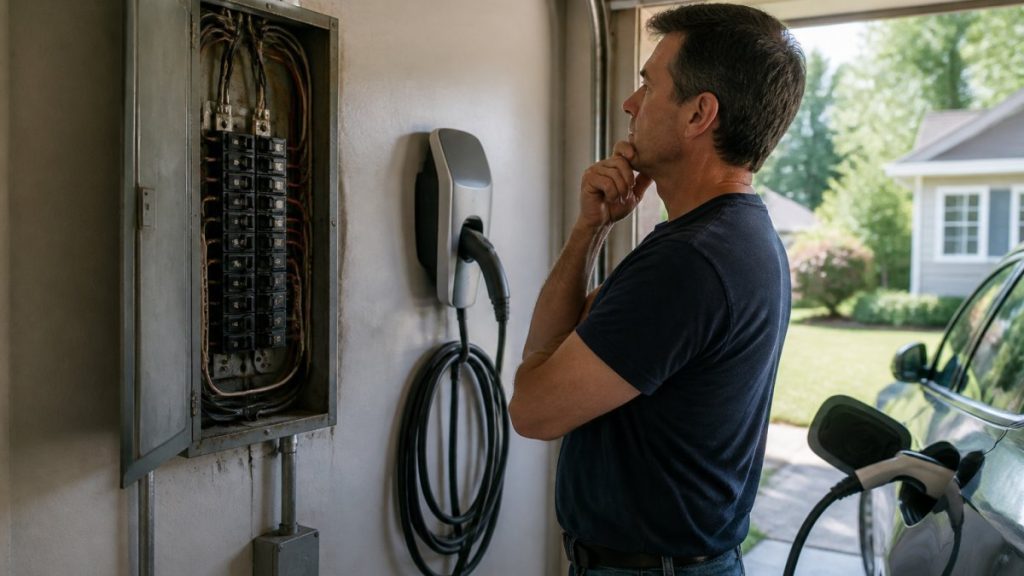
Older electrical panels weren’t designed for modern EV power demands. Homes built in the 1970s, 1980s, and 1990s were sized for basic loads: lighting, heating, and a few appliances at once.
An EV charger changes everything. Even a Level 2 charger draws significant continuous power, and asking outdated infrastructure to handle it is where problems start.
The challenge isn’t whether your panel can technically handle an EV charger, but whether it can do so safely and in compliance with electrical code. Older electrical panels often lack the capacity, breaker configuration, and sometimes physical space for EV charging.
The 100-Amp Panel Limitation
Most homes built before 2000 have 100-amp panels. Generous back then, they’re a tight squeeze today.
A 100-amp panel supplies your entire house. Your AC might draw 30-40 amps, your water heater 20-30, kitchen circuits need dedicated breakers, and a Level 2 EV charger typically requires 30-50 amps of dedicated capacity.
The math doesn’t work. You can’t safely run all of these at once on a 100-amp panel without overloading it.
Newer homes often come with 200-amp panels. This gives you breathing room. A 200-amp panel can usually handle an EV charger alongside other household loads without stress.
Demand Load and Available Capacity
Electrical panels operate on demand load: the actual power your home uses at any given moment, not the theoretical maximum.
When an electrician evaluates whether your panel can handle an EV charger, they calculate what your home demands during peak usage.
The National Electrical Code requires your total connected load never exceed 80 percent of your panel’s capacity during normal operation. This margin prevents overheating, reduces fire risk, and handles unexpected surges.
On a 100-amp panel, that means only 80 amps are safely usable. If your household already consumes 60-70 amps at peak, there’s nowhere left for an EV charger. The real limitation isn’t age, it’s size relative to modern power needs.
How to Assess Your Panel’s Capacity for EV Charging
You can get a rough sense of your panel’s adequacy yourself, but a final determination requires an electrician. Here’s how to start.
Check Your Panel’s Amperage Rating
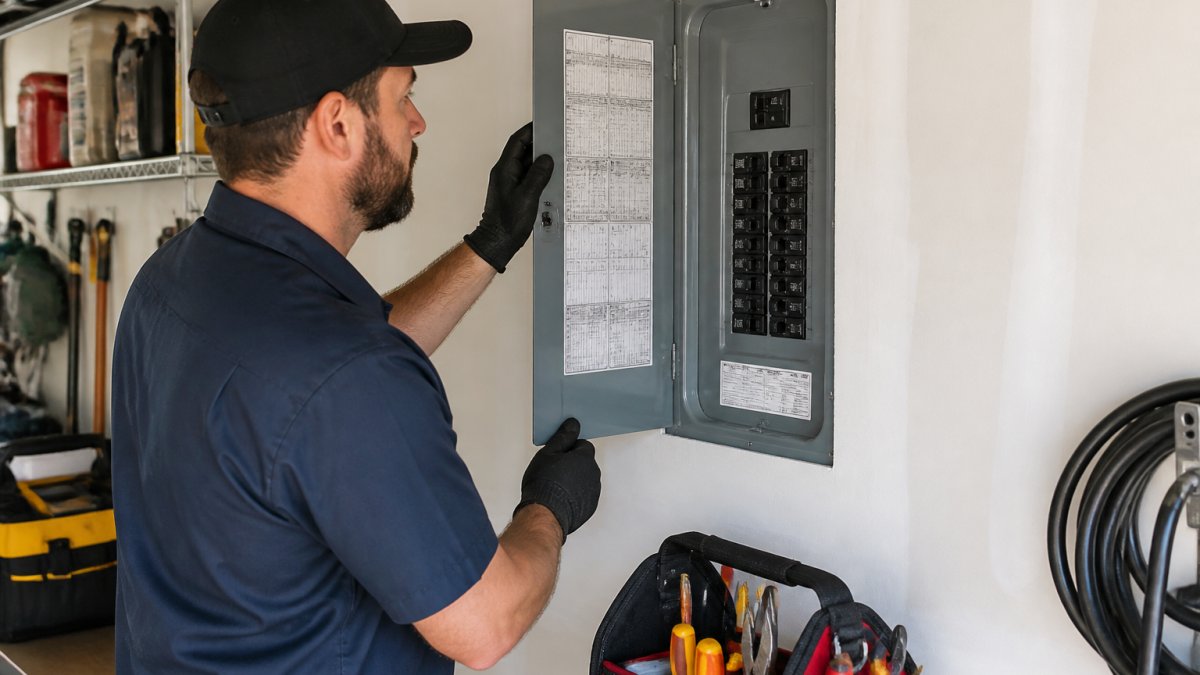
Your panel has a label on the door or inside the cover listing its amperage rating. Open the cover carefully, don’t touch live components, and look for “100A,” “150A,” or “200A.” That’s your total capacity.
Write it down. At 100 or 150 amps, expect capacity constraints. At 200 amps or higher, you’re in better shape, though you still need to verify available capacity after existing loads.
If you’re uncomfortable opening the panel, look at your electrical bill or call your utility company. They can tell you your panel size.
Calculate Load Requirements
Your household has a baseline demand load. To estimate it, add up the amperage of your major appliances:
- Air conditioning system: 30-40 amps
- Electric water heater: 20-30 amps
- Electric dryer: 20-30 amps
- Kitchen circuits (dishwasher, microwave, refrigerator combined): 20-30 amps
- Other circuits (lighting, outlets, garage): 10-20 amps
Your total existing demand could reach 100-150 amps if everything runs at once. It rarely does, but the National Electrical Code requires assuming it might.
A Level 2 EV charger requires a dedicated 40-50 amp circuit on top of existing loads. If your demand is already near capacity, adding one creates a problem.
Understanding Load Calculation for EV Chargers
Load calculation is about understanding how electrical demand works in your home and what safety margins the code requires.
Level 1 vs. Level 2 Charging Demands
Level 1 charging uses a standard 120-volt outlet, draws about 12-16 amps, and adds roughly 3 miles of range per hour. Because the draw is small, it rarely requires a panel upgrade.
Level 2 charging uses a 240-volt dedicated circuit, the same voltage as your dryer or AC, and draws 30-50 amps depending on the model and your service. This is where can older electrical panels handle ev chargers becomes a real question.
Level 2 adds about 25-30 miles of range per hour, fully charging an EV overnight. It’s the practical choice, but it’s also what pushes older panels to their limits.
If your home has a 100-amp panel and you want to install a Level 2 charger, you’re almost certainly looking at a panel upgrade. The code simply won’t allow it without one.
The 25% Rule and Safety Margin
The National Electrical Code applies the 25% rule to EV chargers: the circuit breaker should be sized at 125 percent of the charger’s maximum current draw.
So a Level 2 charger drawing 40 amps needs a 50-amp breaker (40 × 1.25 = 50), a margin for normal surges and current variations.
You also need to ensure adding that 50-amp breaker doesn’t push total panel demand beyond 80 percent of capacity. That’s where the math gets tight on older, smaller panels.
A 100-amp panel with an 80-amp safe capacity can’t accommodate a 50-amp EV charger if you’re already using 50+ amps for other loads. A 200-amp panel with a 160-amp safe capacity has much more flexibility.
Smart EV Charger Load Management Solutions
If your panel is undersized but not critically so, load management technology offers a middle path before you commit to a full panel upgrade.
How Load Management Reduces Demand
Smart load management systems monitor real-time power consumption and adjust the charger’s rate based on what else is running in your house.
If your AC kicks on while you’re charging, the system might temporarily cut the charger’s draw from 40 amps to 20. Once the AC cycles off, charging resumes at full power, keeping total demand below your panel’s safe capacity.
The result is slower charging, but it works: you spread the EV’s draw across time, charging at full speed only when other major loads aren’t running.
When Load Management Is Enough
Load management works best with at least 150 amps of capacity and some existing headroom. In a newer home with a 200-amp panel, it might let you avoid an upgrade altogether.
It’s less practical with a 100-amp panel or a household already near capacity, where the charger would stay throttled down and charge slower than Level 1.
Load management also requires a compatible smart charger, since not all support dynamic load adjustment. Check your charger’s specifications first.
Electrical Panel Upgrade Cost in Austin and Upgrade Options
If load management isn’t practical, a panel upgrade is the permanent solution, and the only way to reliably support an EV charger in an older home.
What a Panel Upgrade Involves
A panel upgrade replaces your existing panel with a larger one, typically going from 100 amps to 200 amps, with twice the capacity and more breaker slots for future circuits.
The work involves disconnecting your main service from the utility, removing the old panel, installing the new one, reconnecting all your existing circuits to the new panel’s breakers, and then reconnecting to the utility.
Beyond the panel itself, you may need to upgrade other components. Your main service entrance, the wires coming from the utility to your house, might need to be larger to support the increased capacity.
Each of these components adds to the total scope of work. Strong Tower Solar Electrical Services & Generators LLC provides free estimates for panel upgrades so you understand exactly what’s involved before committing.
Timeline and Permitting
A panel upgrade requires permits from your local building department. In Austin, the permitting process typically takes 1-2 weeks. Once permits are approved, the actual installation usually takes 1-2 days for the electrician.
However, you’ll need to coordinate with your utility company to disconnect and reconnect your service. This adds scheduling complexity. The whole process from permit application to final utility reconnection usually takes 3-4 weeks.
During the installation day itself, your home will be without power for several hours while the panel is being swapped. Plan accordingly.
Safety and Code Compliance Considerations
Electrical work isn’t an area where DIY shortcuts make sense. Your electrical system is literally what keeps your home safe and prevents fires.
National Electrical Code Requirements
The National Electrical Code sets the standards for all electrical installations in the United States. These rules exist because electrical fires kill people and burn homes down. They’re not bureaucratic red tape, they’re lessons learned from past disasters.
When it comes to EV chargers, the code requires:
- A dedicated circuit breaker sized for the charger
- Proper wire gauge for the current draw
- Ground fault protection on the circuit
- Clearance around the charger for safety and service access
- Compliance with your local utility’s interconnection standards
An unlicensed electrician might install a charger that works, for a while. But if it doesn’t meet code, it creates a fire risk. Insurance might not cover a fire that started in an improperly installed charger. You could face liability if someone is injured.
Why Professional Assessment Matters
A licensed electrician brings three things to the table: knowledge of current code requirements, understanding of your specific home’s electrical system, and accountability if something goes wrong.
When you call Strong Tower Solar Electrical Services & Generators LLC for an EV charger assessment, we’re not just looking at your panel. We’re evaluating your entire electrical system to determine the safest, most code-compliant path forward. Sometimes that’s a load management solution. Sometimes it’s a panel upgrade. Sometimes it’s a combination of upgrades.
We also pull permits and coordinate with the utility. This protects you. If an inspection finds a problem, it gets fixed before the system is energized. If something fails later, there’s a clear record of who did the work and what standards it met.
Next Steps: Getting Your Panel Evaluated
If you’re thinking about installing an EV charger in an older Austin home, the first step is a professional electrical assessment.
Strong Tower Solar Electrical Services & Generators LLC offers free estimates for EV charger installations and panel upgrades. We’ll evaluate your panel, discuss your charging needs, and give you a clear picture of your options.
Don’t guess about electrical capacity. Don’t assume an older panel will work without verification. And don’t hire someone who promises to cut corners on code compliance. Your home’s safety depends on getting this right.
Older electrical panels can handle EV chargers, but most can’t handle them safely without upgrades. If your home has a 100-amp panel, a panel upgrade is almost certainly in your future if you want Level 2 charging.
Frequently Asked Questions
Can I install an EV charger on a 100-amp electrical panel?
A 100-amp panel typically cannot safely support a Level 2 EV charger (which requires 30-50 amps) alongside other household loads. National Electrical Code requires that new circuits use no more than 80% of available capacity. With a 100-amp panel already powering your home’s heating, water heater, and appliances, adding an EV charger leaves insufficient safety margin. A 200-amp panel upgrade is usually necessary, though a licensed electrician can assess your specific situation.
What is the minimum amperage required for a home EV charger?
Level 1 chargers use standard 120-volt outlets and draw 12-16 amps. Level 2 chargers require 240 volts and typically demand 30-50 amps depending on the charger’s rating. Most homes installing a dedicated EV charger use Level 2, which means your panel must have at least 50 amps available after accounting for existing loads. Faster DC fast chargers require 100+ amps and are rarely installed at home. Your electrician will size the circuit based on your charger model and available panel capacity.
How does smart EV charger load management help with older panels?
Smart EV chargers with load management monitor your home’s real-time power consumption and automatically adjust charging speed to avoid overloading your panel. For example, if your air conditioner kicks on, the charger reduces its amperage draw. This allows some older panels to support EV charging without a full panel upgrade, though it may slow charging times. Load management works best on 150-amp or larger panels; 100-amp panels still typically require upgrading even with this technology.
How much does an electrical panel upgrade cost?
Panel upgrade costs depend on your current service size, local permitting requirements, and whether additional wiring work is needed. Contact Strong Tower Solar Electrical Services & Generators LLC for a free estimate tailored to your home’s specific needs. Our licensed electricians will assess your panel, calculate required capacity, and provide transparent pricing before any work begins.